

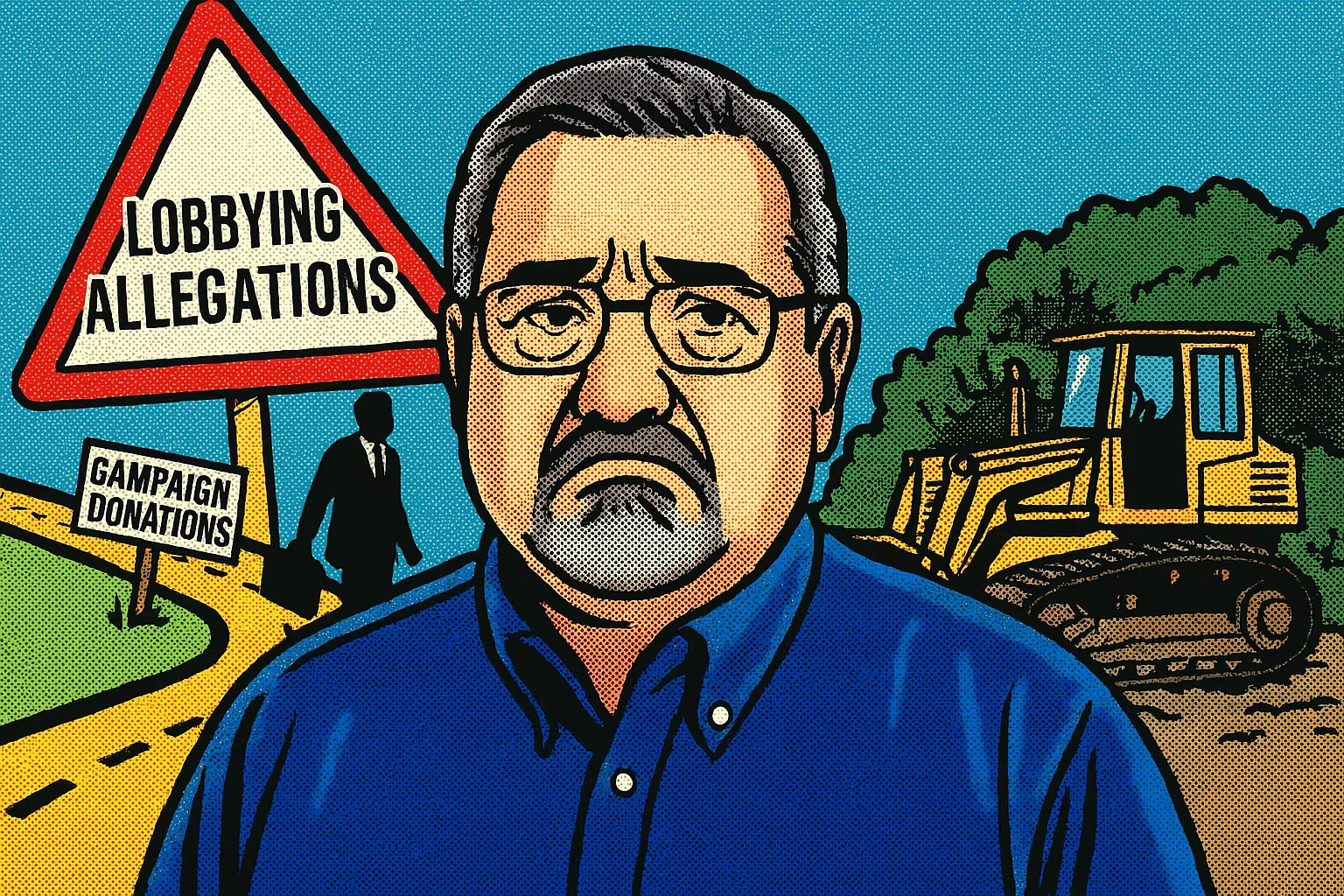
A Deal Made in the Shadows
In early 2025, Sarasota County approved a road agreement that would allow a developer to build a major roadway through 24 acres of county-owned land near Hi Hat Ranch – a parcel long designated for conservation and flood mitigation. What stunned residents and some county staff wasn’t just the location, but the price tag: $14 million in taxpayer money, covering half of the $28 million road project, despite a 2021 policy that clearly placed 100% of the cost on the developer [1].
The change in direction, it turns out, wasn’t accidental. Internal records and call logs obtained by watchdog reporters show that former County Commissioner Al Maio – a longtime advocate for developers – began engaging with county staff and administrators on behalf of the landowner/developer in late 2024, less than two years after leaving office [1]. This has raised red flags about a potential violation of Florida’s two-year lobbying ban on former elected officials [2].

The Role of Al Maio
Maio, who served as a Sarasota County Commissioner from 2014 to 2022, had been known for his pro-growth positions and close ties to the building and real estate sectors. After leaving public office in 2022, Maio began informally working with the Hi Hat Ranch developer and appeared to take the lead in negotiating directly with county staff to shape the terms of the deal.
According to emails and phone logs:
- Maio was copied on more than 160 internal emails related to the project [1].
- He participated in multiple in-person meetings with Sarasota County staff.
- He had more than 40 calls with County Administrator Jonathan Lewis between August and December 2024 [1].
Though Maio was not officially registered as a lobbyist, his involvement had the hallmarks of private advocacy. Florida Statute 112.313(9)(a)4 prohibits former commissioners from lobbying their former agency within two years of leaving office. County officials have insisted that Maio did not engage in direct lobbying because he was “just helping facilitate conversations,” but critics, including the Florida Center for Governmental Accountability (FLCGA), say the volume of private communications and his behind-the-scenes role amount to de facto lobbying [2].
Bypassing Policy and Public Input
The decision to shift financial responsibility to the public flies in the face of Sarasota County’s own 2021 Mobility Fee policy, which required developers to cover road costs tied to new development in East Sarasota. That policy was the result of a lengthy public process, meant to protect taxpayers from subsidizing urban sprawl.
But internal emails show that county staff, after Maio’s intervention, reversed their earlier position and began recommending a 50/50 cost split – contradicting their prior written position to the Commission. Several planners expressed discomfort privately, but their concerns were overridden [1]. The change was never explicitly presented to the public in open session. Commissioners were also not informed of the projected impact on traffic to the already overburdened Bee Ridge Road corridor, which will carry thousands of new vehicle trips once the Hi Hat Ranch expansion is complete [1].
The Public Responds
The deal was quietly approved in February 2025 as part of a broader development package. But when it came to light through investigative reporting by WGCU and the Florida Trident, public outrage surged. Residents and civic groups accused the county of facilitating a developer giveaway, aided by insider influence and a lack of transparency.
Local good-government advocates warned the process undermined the Sunshine Law, which guarantees the public’s right to see and participate in government decision-making [3]. In response to the backlash, Commissioner Neil Rainford requested a staff review of all communications related to the Hi Hat deal and called for the agreement to be placed back on a future agenda for re-evaluation [1].
As of July 2025, no formal ethics complaint has been filed against Al Maio, and the State Commission on Ethics has not launched an investigation. However, pressure is building for one. Some community leaders have suggested that Maio’s actions be reviewed not only under lobbying restrictions but for potential violations of the county’s own ethics code.
What Comes Next
With the project still in preliminary engineering phases, critics hope that the Commission will halt or renegotiate the deal before public funds are committed. Calls have also grown louder for Sarasota County to implement clearer guidelines for post-employment restrictions and to require mandatory lobbyist registration, even for former officials working informally.
For now, the Hi Hat Ranch road deal remains a test of Sarasota’s political integrity: a moment when public officials must decide whether to uphold the spirit of transparency or allow quiet influence to shape millions in taxpayer spending.
Sources:
- [1] WGCU News / Florida Trident / Florida Center for Governmental Accountability joint investigation: “Secret Deal Over Hi Hat Ranch Draws Ethics Concerns.” Published June–July 2025. Available at: https://www.wgcu.org/local-news/2025-07-01/hi-hat-ranch-developer-deal
- [2] Florida Statute 112.313(9)(a)4: Code of Ethics for Public Officers and Employees – Two-Year Lobbying Ban. Florida Legislature official website: https://www.leg.state.fl.us/statutes/
- [3] Florida Sunshine Law, Chapter 286, Florida Statutes. Accessed via First Amendment Foundation: https://floridafaf.org/sunshine-law